
ADHD Services for kids
Therapeutic, skills-building, and family-aligned care that works with how your child’s brain actually functions.
Neurodivergent-Affirming ADHD Support for Children and Adolescents
When everyday life feels harder than it should, the goal isn’t to push your child harder — it’s to understand what their nervous system needs.
Many families come to STG Health Services because their child is bright, curious, and capable — yet daily routines, school demands, emotional regulation, or transitions feel like constant battles.
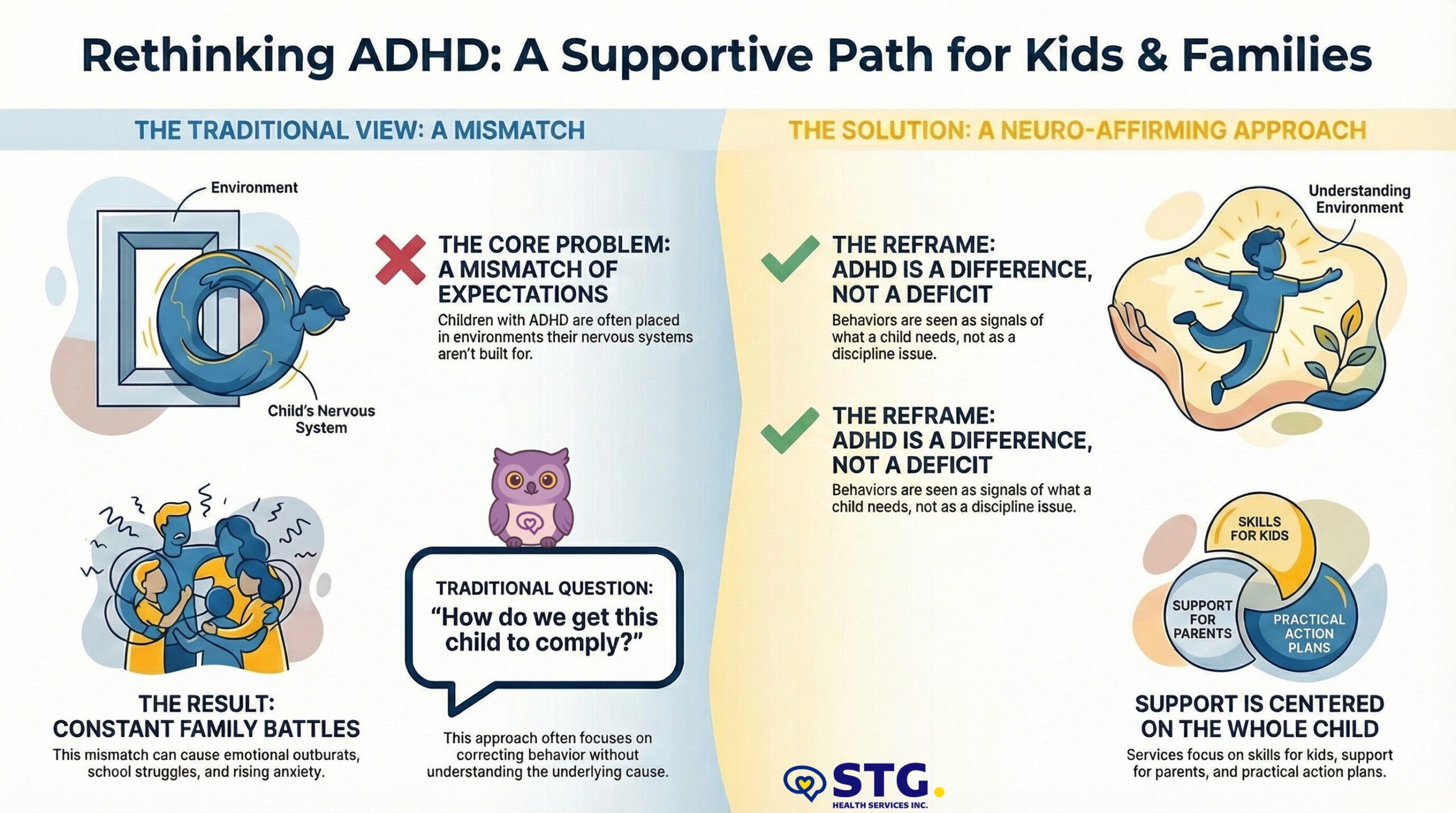
Traditional approaches often focus on correcting behaviour without understanding why it’s happening. Our services for kids take a different and more affirming approach.
Jump to: Skills for Kids | Parenting Supports | Intervention Planning | Sleep for Teens
The Problem Most Families Face
Children with ADHD are often expected to function in environments that demand sustained attention, emotional control, and executive skills their nervous systems are still developing — or may develop differently.
As a result, families may see:
- Frequent emotional outbursts, shutdowns, or overwhelm
- Difficulty with routines, transitions, or following multi-step tasks
- Struggles at school despite strong abilities
- Rising frustration, shame, or anxiety in the child
- Parents feeling unsure whether to push harder or back off
The problem is rarely motivation or effort. More often, it’s a mismatch between expectations and how the child’s brain actually works.
The Reframe: ADHD Is Not a Behaviour Problem
At STG Health, we approach ADHD in children as a neurodevelopmental difference, not a discipline issue or parenting failure. Behaviors are understood as signals of regulation, capacity, and environmental fit.
Instead of asking, “How do we get this child to comply?”
We ask, “What support does this child need to function with less strain?”
This reframe changes everything — for the child and for the family.
The Path Forward: ADHD Support That Fits the Child
ADHD Skills for Kids
Children learn best when skills are taught in ways that feel safe, engaging, and relevant. ADHD skills work focuses on building capacity without pressure or shame.
- Awareness of energy, attention, and emotional states
- Tools for emotional regulation and frustration tolerance
- Support with organization, transitions, and task initiation
- Sensory-based strategies to support focus and calm
- Strength-based learning through play and engagement
Skills are practiced in ways that match developmental level and nervous system readiness — not forced through rigid routines.
Context-Rich, Family-Centered Exploration
ADHD & Kids: Understanding the Whole Child
ADHD often affects more than attention. It shows up in emotion, identity, relationships, and the everyday rhythms of home, school, and play. Our approach helps families and children make sense of these patterns in context. Key areas of exploration include:
- How ADHD influences learning, behaviour, and emotional responses
- Why certain environments escalate stress or shutdown
- How sensory needs and regulation interact with behaviour
- How strengths and challenges coexist
- How to support the child without over-correcting or rescuing
The goal is clarity — not labels — so families can respond more effectively and compassionately.
(Kids Assessed Elsewhere)
ADHD Action & Intervention Planning
Some children complete an ADHD assessment and receive a diagnosis—but families are left without clear, practical guidance on what to do next. ADHD Action & Intervention Planning for Kids is designed for families who already have an assessment report and want targeted, usable support.
This service includes a brief caregiver follow-up screener to understand how ADHD is currently affecting a child’s daily functioning, a careful review of the existing assessment, and the development of a new, individualized intervention plan. Plans are neurodivergent-affirming, developmentally appropriate, and focused on reducing strain across home, school, and daily routines.
Even if a prior assessment did not result in an ADHD diagnosis, this service may still be helpful. In these cases, the focus is on problem-solving ADHD-like challenges and identifying strategies that support day-to-day functioning.
This service does not replace a full assessment or therapy; it provides a structured bridge between assessment findings and meaningful support for children and families.
(For when Teens get Tired of NOT Sleeping)
ADHD & Sleep Support for Teens
Sleep difficulties are common in children and adolescents with ADHD and often make attention, emotional regulation, and daily functioning harder. Our ADHD-adapted CBT-I service uses the SIESTA model to support sleep in ways that fit how neurodivergent nervous systems work.
Rather than enforcing strict routines or rules, this approach focuses on understanding sleep patterns, reducing evening strain, and building flexible, sustainable strategies that improve rest and daytime regulation. Parent involvement is collaborative and supportive, not behaviour-focused.
How Families Are Supported
Parents and caregivers are a key part of successful ADHD support. Services often include guidance for caregivers alongside child-focused work.
- Coaching around routines, transitions, and expectations
- Support for communication that reduces power struggles
- Understanding regulation before behaviour
- Strategies that work at home and school
- Reducing family stress and conflict
This is not about controlling behaviour.
It is about reducing friction in daily life.
What Working Together Is Like
Families often describe this work as calm, practical, and relieving. Sessions are collaborative and responsive to the child’s attention, energy, and comfort. Care is paced intentionally, grounded in real-world challenges, and focused on reducing pressure rather than increasing compliance.
Progress is measured by smoother routines, fewer emotional escalations, increased confidence, and a child who feels more understood — not by perfection or performance.
Is This Right for My Child?
This support may be a good fit if your child:
- Struggles with attention, transitions, emotional regulation, or daily routines
- Becomes easily overwhelmed, frustrated, or shut down
- Has been described as “bright but inconsistent” or “trying hard but still struggling”
- Experiences stress related to school, expectations, or sensory input
- Needs support that goes beyond behavior charts or discipline strategies
This approach may not be the right fit if you are seeking rapid behaviour compliance, punishment-based interventions, or performance-focused treatment without caregiver involvement.
If you are unsure, a consultation offers space to talk through your child’s needs and decide together whether this approach is appropriate.