
ADHD & Kids
Neuronurture™: ADHD Parenting Support for Kids (Ages 4–11)
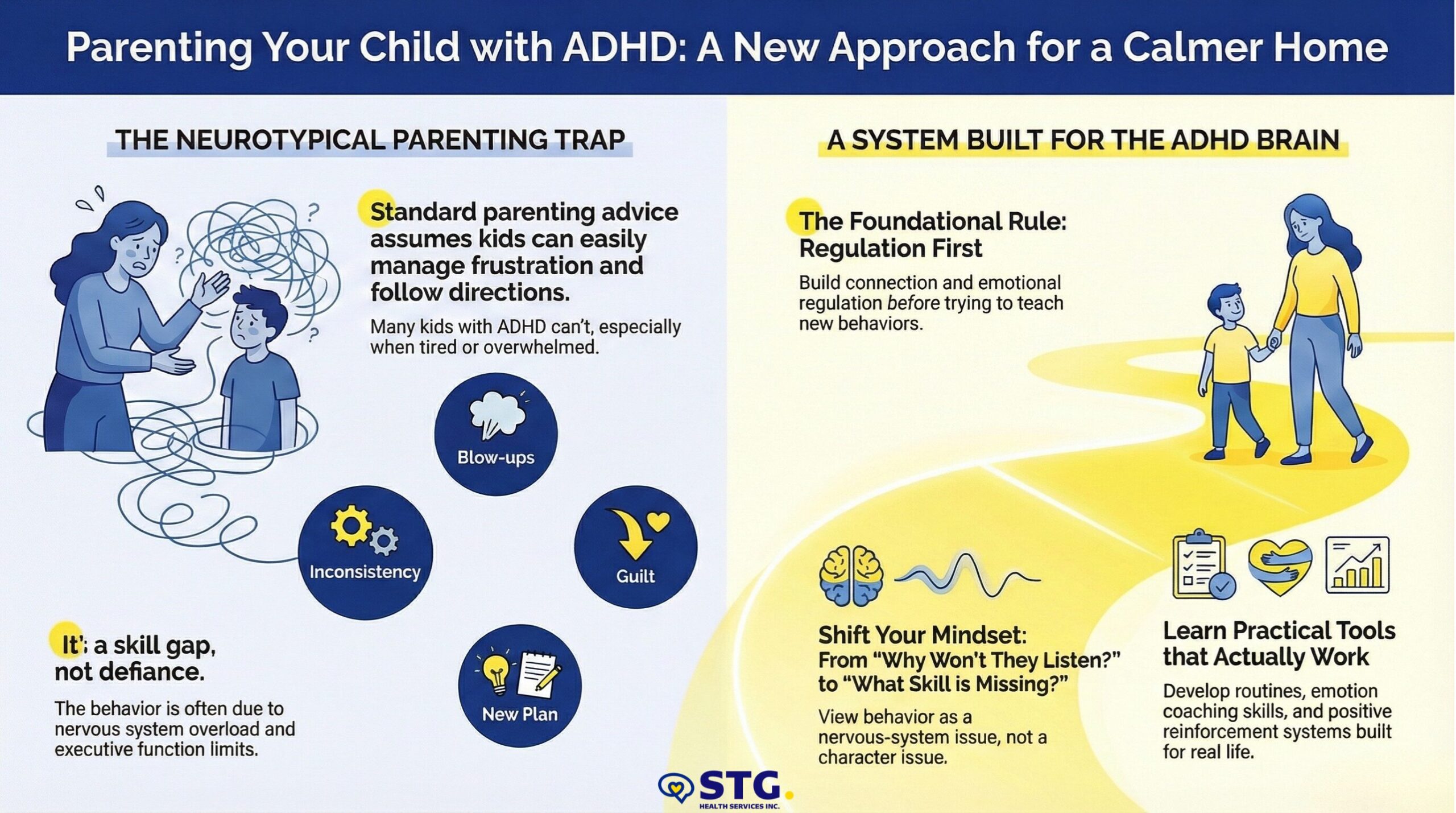
Most parenting advice assumes a child can shift gears, tolerate frustration, and follow multi-step directions consistently. Many kids with ADHD can’t—especially when they’re tired, overwhelmed, or dysregulated. That’s not defiance; it’s nervous-system overload meeting executive-function limits. We teach you how to lead differently so your child can succeed differently.
Best fit if you’re dealing with transitions, meltdowns, routines that won’t stick, homework friction, impulsive behaviour, or parent burnout.
Regulation first. Capacity second. Systems third. That’s how consistency becomes possible.
No formal diagnosis required to begin. Virtual care for Saskatchewan residents.
Quick Read (60 seconds)
If parenting feels like a cycle of blow-ups → guilt → new plan → inconsistency → repeat, you’re not alone—and you’re not failing.
Many parenting strategies assume a neurotypical brain. ADHD changes routines, transitions, emotional regulation, and follow-through, so “standard” discipline often doesn’t hold.
Neuronurture™ is a structured, science-backed program with practical tools (not generic advice) designed specifically for families raising a child with ADHD.
You’ll leave with a clear, doable home plan: connection tools, routines/visual supports, positive reinforcement, logical/natural consequences, and emotion coaching—built for real life.
“Prefer to skim? Jump to: Options • What You Get • What to Expect • FAQ“
Does any of this feel familiar?
- Mornings and bedtimes feel like daily battles
- Homework is a meltdown waiting to happen
- Transitions (screens off, shoes on, out the door) escalate fast
- Your child knows the rule… and still can’t follow it consistently
- You’re constantly “on,” and you’re exhausted
- You swing between being too strict and too lenient because nothing works
You’re not failing—your child’s brain needs a different kind of support
ADHD is not just about attention. In many kids it shows up as:
- Focus and sustained effort challenges
- Impulsivity (blurting, risk-taking, reacting before thinking)
- Emotional regulation difficulty (big feelings that come fast and feel unmanageable)
- Social friction (interrupting, conflict cycles, repair difficulty)
When a child is dysregulated, they can’t “access” skills on demand. And when parents are depleted, consistency becomes biologically harder too.
Our core premise:
Build regulation and connection first—then install structure and behaviour tools that actually hold under pressure.
The missing piece most parenting advice leaves out
Most parenting advice assumes your child can reliably:
shift attention when asked
tolerate boredom or frustration
transition without ramping up
remember multi-step instructions
That’s often not how ADHD works—especially when stress, sensory sensitivity, or fatigue is involved.
Neuronurture™ is designed to reduce power struggles and increase cooperation by combining:
positive reinforcement
logical and natural consequences
emotional coaching
structured routines and visual supports
The three shifts that make change sustainable
Shift 1 — From “Why won’t they just listen?” to “What skill is missing here?”
We stop treating behaviour as a character issue and start treating it as a skills + nervous-system issue.
Shift 2 — From lectures and punishment to structure + reinforcement that fits ADHD
Traditional discipline often fails for ADHD. We build plans that actually work in real life.
Shift 3 — From “I need to be perfectly consistent” to “I need a system that helps me stay consistent”
You’ll learn repeatable steps you can return to—even after a bad day.
Which shift feels most true for your family right now?
Treatment Options
Option A — Neuronurture™ ADHD Parenting Program (Kids 4–11)
Best for: impulsivity, emotional outbursts, routine battles, homework stress, transitions, defiance/power struggles, and parent burnout.
Neuronurture™ is built as a step-by-step program with 13 sessions, integrating behavioural psychology, emotional regulation strategies, and structured parenting techniques.
Parents/caregivers of children who have ADHD (diagnosed or strongly suspected)
Families who want a clear roadmap rather than more theory
Parents who want support that is practical, non-shaming, and sustainable
Connection & communication: child-led play, warmth, positive attention, increasing cooperation
Routines that work with ADHD: morning/bedtime/homework, visual schedules, task breakdown, smoother transitions
Emotion coaching & coping skills: breathing, sensory supports, calming plans, impulse control scaffolding
Behaviour support: positive reinforcement, logical consequences, structured time-outs—without power struggles
Problem-solving & social skills: conflict repair, sibling dynamics, peer challenges
Parent self-care: practical strategies to reduce depletion so you can lead consistently
Option B — Parent Coaching (1:1)
Best for: complex family systems (co-parenting differences, multiple neurodivergences, high stress), or if you prefer a tailored plan over a structured program.
We’ll build:
a home routine system
a reinforcement plan that fits your child
a meltdown/repair plan
support for school collaboration
What you Get
(a clear, tangible plan)
A clear formulation of your family’s ADHD patterns and “stuck loops”
A step-by-step routine build (morning, homework, bedtime) with visuals
A reinforcement system that reduces nagging and increases cooperation
Emotion regulation supports (calm plans, sensory supports, repair scripts)
Behaviour tools that fit ADHD (logical/natural consequences, time-outs done well)
Worksheets, tracking tools, and a session-by-session binder approach
Optional access to STG Online Clinic resources (see below)
What to Expect
(simple, predictable steps)
Step 1 — Book an Intake
We learn what’s happening, what you’ve tried, and what you want to be different.
Step 2 — Identify patterns and priorities
We clarify the ADHD-related friction points (routines, emotions, school, sibling dynamics, parental depletion).
Step 3 — Recommend your path
You’ll leave with a clear direction: Program (Option A), 1:1 coaching (Option B), or an integrated plan (Option C).
Step 4 — Start building change you can sustain
You’ll leave with practical next steps for the next 2–4 weeks—so you’re not leaving with insight only.
STG Online Clinic
(included for clients)
As part of your care, you may also receive access to the STG Online Clinic — a secure library of over 25 self-paced courses designed to support ongoing learning and skill development.
The Online Clinic is not a replacement for therapy or medical care. It is intended to complement your assessment and treatment plan, giving you practical tools you can return to between sessions and over time.
Courses focus on areas such as:
Executive function skills, including task initiation, follow-through, and planning
Emotional regulation tools to support focus, stress tolerance, and recovery after overwhelm
Building daily structure with ADHD, including routines that adapt to fluctuating energy and attention
- Women and ADHD, focusing on how ADHD typically impacts women differently
- Digital Wellbeing, addressing the hyperfocus on technology
Content is designed to be practical, accessible, and flexible, allowing you to engage at your own pace and revisit material as your needs change.