
CBT-I for ADHD
Evidence-Based Sleep Support for Adolescents with ADHD
If sleep were easy, you’d already be sleeping.
Lying awake. Delaying bedtime. Feeling exhausted but not sleepy. Waking unrefreshed. Then starting the day already behind.
If that cycle feels familiar, this program was built for you or your child.
Looking for CBT-i for Adults with ADHD? Take a Look Here
Quick Read (60 seconds)
Sleep difficulties are common in adolescents and adults with ADHD and are not caused by poor habits or lack of effort
ADHD affects how the brain regulates arousal, motivation, and biological timing, making it hard to feel sleepy at night—even when exhausted
Traditional sleep advice often fails because it assumes consistency and early sleepiness that ADHD nervous systems don’t reliably produce
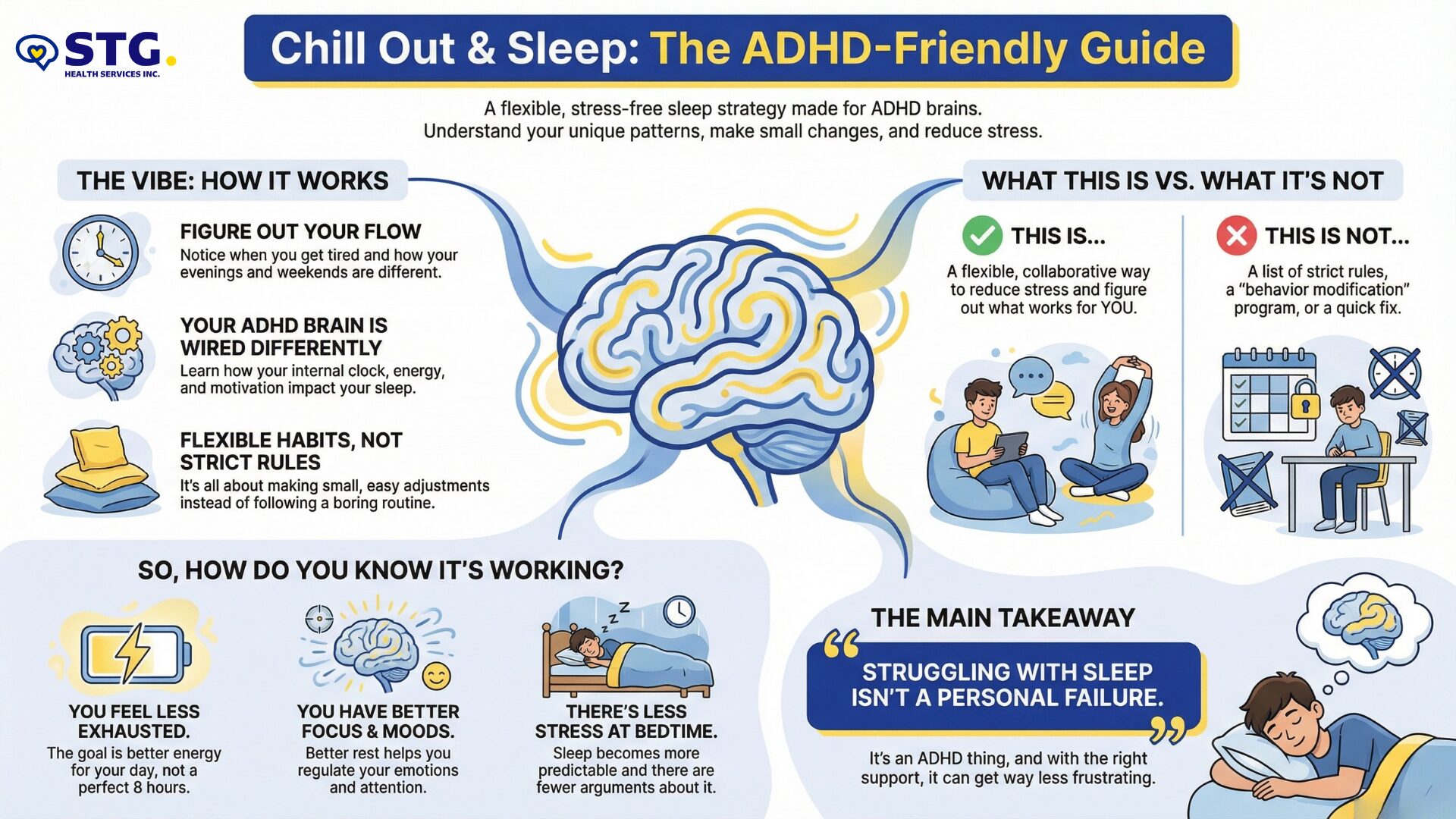
The approach focuses on understanding sleep patterns, reducing evening friction, and supporting regulation rather than enforcing rigid rules
Strategies are adapted for ADHD using motivational interviewing, flexible sleep hygiene, and personalized sleep planning
The aim is not perfect sleep, but reduced exhaustion, improved daytime regulation, and greater predictability
The focus is on less strain and better functioning, not blame or pressure
Prefer to skim? Jump to: Solution • Who is this for? • Parent FAQ • Teen FAQ
The Real Problem Isn’t Sleep — It’s the Mismatch
ADHD changes how sleep pressure builds, how the circadian clock shifts, and how motivation and attention regulate in the evening. Standard sleep advice assumes a nervous system that can slow down on demand.
For ADHD nervous systems, that assumption fails. The result is a cycle many clients recognize:
- Difficulty feeling sleepy at a “reasonable” hour
- Late nights driven by hyperfocus, avoidance, or stimulation
- Shortened or fragmented sleep
- Increased inattention, irritability, and emotional strain the next day
- Growing frustration, self-criticism, and pressure to “try harder”
More effort doesn’t fix this cycle.
A different approach does.
The Reframe: Sleep Is a Regulation Issue, Not a Compliance Issue
Sleep problems in ADHD are not caused by laziness, poor motivation, or bad habits alone. They reflect differences in neurobiology, timing, and regulation.
Effective sleep support must:
- Work with ADHD traits, not against them
- Reduce strain instead of adding rules
- Support autonomy rather than enforce compliance
- Be structured, but flexible
This is where ADHD-adapted CBT-I — and the SIESTA model — comes in.
The Solution: CBT-I Adapted for ADHD
This service is based on CBT-i — a structured, evidence-based cognitive-behavioral sleep intervention developed specifically for individuals with ADHD.
Rather than applying generic CBT-I protocols, this approach adapts sleep treatment to ADHD-specific patterns in attention, motivation, circadian rhythm, and executive functioning.
What the Program Focuses On
This program is designed to reduce strain around sleep by helping you understand how ADHD influences sleep regulation and by supporting change in ways that fit your nervous system.
Understanding sleep patterns, including sleep pressure, evening timing, and weekday–weekend differences
Learning how ADHD affects the biological clock, arousal, motivation, and reward sensitivity
Adapting sleep hygiene through small, feasible, ADHD-aligned adjustments
Supporting change through autonomy, collaboration, and experimentation rather than compliance
Creating a personalized sleep plan focused on reduced exhaustion and improved daily regulation
The aim is not to control sleep, but to create conditions that allow your nervous system to settle more reliably over time.
Why This Approach Is Different
Traditional CBT-I often fails ADHD clients because it assumes consistency and self-regulation that ADHD makes difficult.
It works because it:
- Is designed specifically for ADHD
- Integrates executive functioning and motivation
- Uses structure without rigidity
- Centers lived experience
- Is supported by clinical research showing improvements in sleep in adolescents with ADHD
The focus is on interventions that support capacity — not control behavior.
Who This Service Is For
This service may be a good fit if you or your child:
Have ADHD and ongoing sleep difficulties
Feel exhausted despite “trying everything”
Notice sleep worsening attention or emotional regulation
Want evidence-based support that respects neurodivergence
Who is this Service not for?
This service is not intended for untreated primary sleep disorders (including Sleep Apnea) requiring medical management.
What Working Together Is Like
Clients often describe this program as relieving and validating. Sessions are structured but paced to attention and energy. The focus is on reducing pressure, increasing clarity, and building trust in your body’s rhythms — not forcing sleep to happen.
A digital workbook is provided to both the adolescent client and their parents. In addition, the client and parents are granted access to the STG Online Clinic, our secure learning management system.
All appointments are virtual through secure video conferencing, in Saskatchewan only.
Parent FAQ - Quick Answers
CBT-I for ADHD is cognitive-behavioral sleep support adapted specifically for ADHD. Unlike standard sleep approaches that rely on rigid routines and consistency, this service accounts for differences in circadian rhythm, motivation, arousal, and executive functioning common in ADHD.
No. While sleep hygiene may be discussed, this approach goes beyond general advice. It focuses on understanding why sleep is difficult for a child with ADHD and creating individualized, realistic strategies that reduce strain rather than add pressure.
This service commonly supports children and adolescents who:
Take a long time to fall asleep
Have delayed sleep timing or irregular sleep patterns
Feel tired but not sleepy at night
Experience increased ADHD symptoms when sleep is poor
Feel anxious, restless, or mentally “wired” in the evening
No. This service does not replace medical treatment or medication management. When medication is part of care, sleep patterns are discussed thoughtfully and, when appropriate, coordinated with medical providers.
No. The model avoids rigid rules. Changes are introduced gradually, collaboratively, and only when they make sense for the child. The focus is on feasibility, motivation, and nervous system regulation—not compliance.
Caregivers are involved in assessment and planning, especially for younger clients. You may be asked to provide background information, complete brief screeners, and support changes at home in ways that align with your child’s needs and autonomy. Parent involvement is collaborative, not punitive.
This is a structured, time-limited intervention. The exact length depends on age, needs, and pacing, but it is not intended to be open-ended therapy.
That is common. The model uses motivational interviewing, which respects ambivalence and avoids forcing change. Children are supported to identify their own goals and experiment with strategies at a pace they can tolerate.
Often, yes. Sleep difficulties frequently interact with anxiety, mood, and regulation challenges. These connections are considered carefully as part of the work. If another condition requires different or additional care, this will be discussed openly.
The goal is not perfect sleep. Progress is measured by reduced strain and improved functioning, not by strict sleep metrics alone. Outcomes typically focus on:
Reduced exhaustion
Improved predictability around sleep
Better daytime regulation and attention
Less stress and conflict around bedtime
CBT-I for ADHD — Teen FAQ
With ADHD, being tired doesn’t always mean your brain is ready to sleep. ADHD affects how sleep pressure builds and how alert your brain stays in the evening. That’s why you might feel wiped out but still wired at night. This isn’t a failure — it’s how your nervous system works.
Your sleep problems are not because you’re lazy, broken, or doing it wrong.
They make sense given how your brain works — and they can become easier with the right support.
No. This approach is not about forcing earlier bedtimes or following strict rules. It’s about understanding when your brain actually becomes ready for sleep and helping your system settle more naturally over time.
Not automatically. We look at how evening activities affect your alertness and sleep timing and then decide together what’s worth changing. You won’t be told to give everything up — the focus is on reducing friction, not removing enjoyment.
That’s okay. This approach uses choice-based change, which means you don’t have to force yourself to do anything. We talk about what you want to be different and experiment at a pace you can tolerate.
The goal isn’t perfect sleep. Even small improvements can make a big difference. The goal is:
Feeling less exhausted
Having more predictable sleep
Waking up with better focus and emotional control
Having fewer battles with your body at night
It’s a structured, short-term sleep program based on CBT-I, adapted specifically for ADHD. We focus on sleep, regulation, and how ADHD affects both — not on everything else in your life unless it’s relevant.
That depends on your age and situation. Parents are usually involved in planning and support, but this approach still respects your autonomy. You won’t be treated like a child who needs to be controlled.
That’s very common with ADHD. Most sleep advice isn’t designed for ADHD brains. This program is different because it’s built specifically around how ADHD affects sleep timing, motivation, and arousal.
Sessions are structured but flexible. No lectures. No punishment. No pressure. We:
Talk about what your sleep actually looks like
Use simple tracking (not perfection)
Learn how ADHD affects sleep
Try small experiments and adjust
Build a plan that fits your real life
Nothing bad happens. There’s no failing here. Sleep changes aren’t linear, especially with ADHD. We expect variability and work with it rather than against it.