
ADHD & Sleep
Sleep support that finally works with your ADHD brain
If you’re exhausted all day and then wide awake at night, you’re not alone—and you’re not doing it wrong.
Many adults with ADHD live in the same loop:
Tired all day → “second wind” at night → racing thoughts / scrolling / hyperfocus → late sleep → morning brain fog → shame → repeat.
At STG Health, we treat ADHD sleep the same way we treat ADHD follow-through: we build regulation and capacity first, then we work on systems that can hold under real-life pressure. Because when your nervous system can’t downshift, “sleep hygiene” isn’t enough.
Next cohort: August (8-week virtual group)
Availability: Saskatchewan residents only
Looking for Sleep supports for your child? CBT-i for ADHD for Adolescents
Quick Read (60 seconds)
If you’re wired at night and foggy in the morning, it may not be a discipline problem—ADHD shifts circadian rhythm, arousal, and dopamine timing.
Most sleep advice assumes a neurotypical brain. This program is ADHD-adapted CBT-I plus regulation tools that account for executive dysfunction and sensory overwhelm.
Best for adults with ADHD (diagnosed or strongly suspected) who want a structured, supportive, therapist-led reset.
You’ll leave with a personalized sleep plan, weekly tools that are realistic to apply, and a relapse-prevention approach for when life disrupts your routine.
Prefer to skim? Jump to: Options • What You Get • What to Expect • Fee & Coverage • FAQ
Does any of this feel familiar?
- You feel tired all day, then alert at night
- Your brain won’t shut off (rumination, planning loops, “just one more thing”)
- You intend to go to bed… and lose time to task inertia or scrolling
- You finally fall asleep late—then wake up foggy, behind, or emotionally raw
- You’ve tried “sleep hygiene,” melatonin, or strict routines—and it didn’t stick
You’re not broken—your system is overactivated
ADHD doesn’t only affect focus. It changes the systems that govern:
- Circadian timing
- Arousal and downshifting
- Reward/dopamine patterns
- Sensory processing
- Executive control (starting/ending routines)
When those systems are out of sync, the brain prioritizes short-term relief over long-term consistency—especially at night.
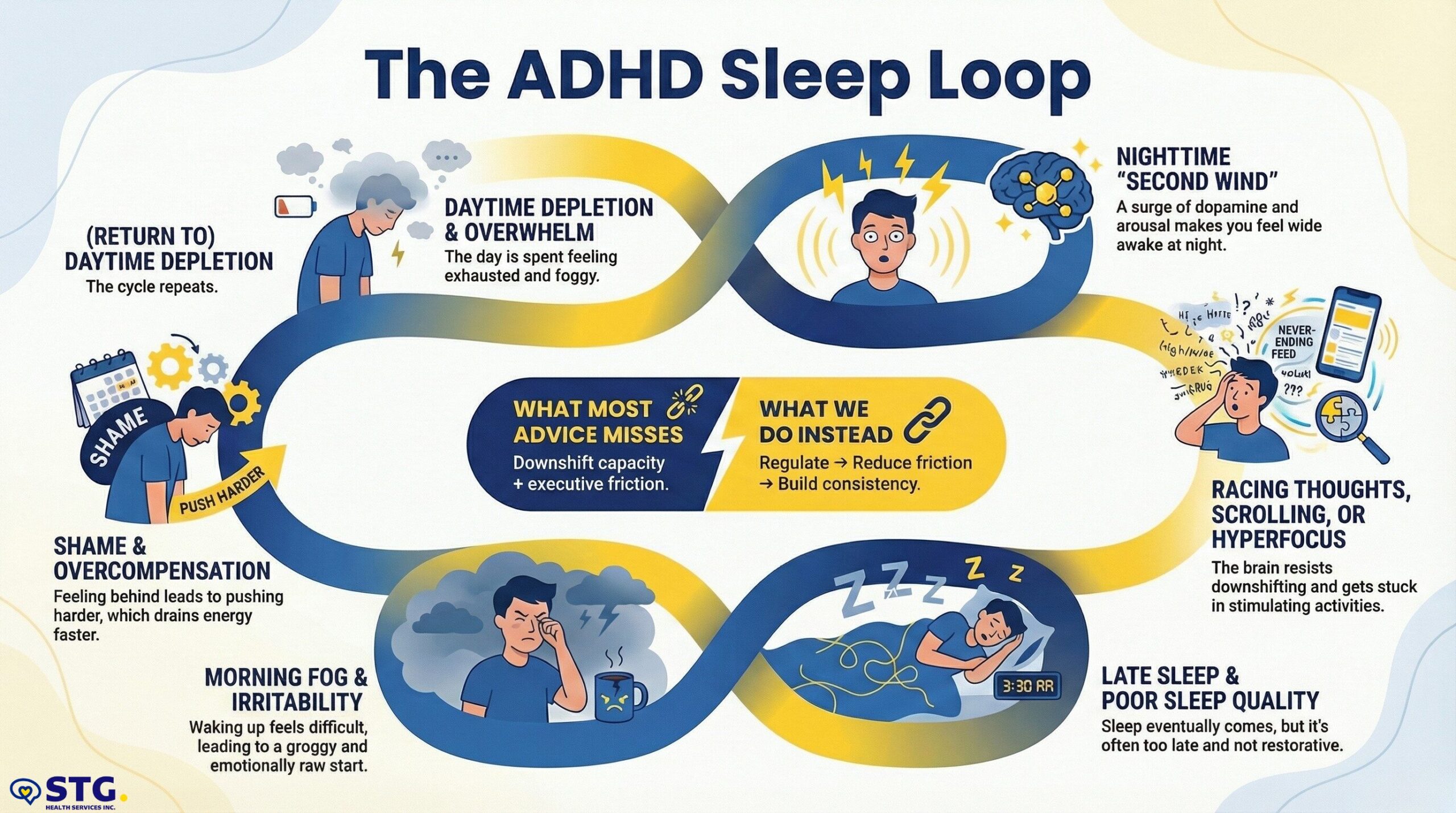
The missing piece most sleep advice leaves out
Most sleep advice assumes your brain can reliably:
notice time passing
transition away from stimulation
tolerate boredom
execute a linear bedtime routine
That’s not how many ADHD brains work—especially when stress, overwhelm, or sensory sensitivity is present.
Our premise is simple:
When downshift capacity improves, sleep strategies become usable—because you’re no longer trying to force sleep with a flooded nervous system.
That’s why we start with regulation and capacity, then build systems that can hold under pressure.
Why we treat ADHD & Sleep this way
Many people arrive having tried “everything,” yet the loop keeps returning:
tired → wired → late sleep → brain fog → shame → overcompensation → crash → repeat
The turning point is recognizing: this isn’t a character flaw. Sleep is not only a habit issue; it’s also a regulation and rhythm issue.
So we work in the order that supports real change:
Stabilize arousal and downshifting (so sleep can happen)
Build an ADHD-adapted sleep system (so it can hold under pressure)
Strengthen consistency over perfection (so setbacks don’t become spirals)
The three shifts that make sleep change sustainable
Shift 1 — From “I need more discipline” to “my sleep system needs a different approach”
We map your personal ADHD-Sleep loop with clarity and compassion—so you can respond with strategy instead of self-judgment.
Shift 2 — From rigid routines to small, realistic steps
We use ADHD-friendly tools that still work when you’re tired, stressed, or dysregulated.
Shift 3 — From “sleep hygiene” to ADHD-adapted CBT-I + regulation skills
We address circadian delay, sensory load, dopamine timing, and executive-function barriers—so your plan matches your brain.
Which shift feels most true for you right now?
Treatment Options
Option A — The ADHD Sleep Reset Group (8 weeks)
Best for: ADHD-style sleep dysregulation (tired all day, wired at night), overthinking at bedtime, time blindness, sensory sensitivity, and difficulty making routines stick.
This is a live, virtual, therapist-led program using an ADHD-adapted CBT-I framework—delivered with a neurodivergent-affirming tone (no shame, no “shoulds”).
A formal ADHD diagnosis is not required. This group is designed for adults who:
have ADHD (diagnosed or strongly suspected)
struggle to fall asleep, stay asleep, or wake feeling rested
get pulled into nighttime spirals (scrolling, hyperfocus, rumination)
want structure, support, and a clear weekly plan
prefer learning in a small, supportive online group
This program may not be the right fit right now if you’re experiencing untreated sleep apnea/narcolepsy, unstable mania, uncontrolled PTSD nightmares, severe chronic pain flare-ups, or active suicidality. In those situations, we help you get the right level of stabilization first.
Week 1 — The ADHD–Sleep Loop (Not Your Fault)
Week 2 — Managing Your Energy (The Daytime Fix)
Week 3 — Offloading the Brain (Cognitive Wind-Down)
Week 4 — Re-Training the Bed (Stimulus Control, ADHD-adapted)
Week 5 — Resetting the Clock (Circadian Rhythm Reset)
Week 6 — Soothing the Senses (Sensory Optimization)
Week 7 — Integration (Your 24-Hour Rhythm, without perfection)
Week 8 — Relapse Prevention (Sustainable Sleep)
Option B: Individual ADHD & Sleep Focused Therapy
Best for: Adults who want personalized support for ADHD-related sleep issues (tired–wired cycles, bedtime avoidance, racing thoughts, circadian delay, sensory overload, inconsistent routines) and prefer 1:1 therapy over a group format.
If your nights feel like a battle with your brain, you don’t need more willpower—you need an approach that works with your nervous system and your ADHD patterns.
In individual therapy, we help you:
understand your specific ADHD–sleep loop (and why it’s not an effort problem)
build downshift capacity so your body can actually transition into sleep
install an ADHD-adapted sleep system that holds up under real life
reduce the shame spiral and replace it with practical, repeatable steps
Individual ADHD & Sleep Focused Therapy is a good fit if you:
want a plan tailored to your brain, body, and schedule
have comorbid anxiety/stress that intensifies at night
need flexibility (shift work, parenting, inconsistent routines)
want deeper support around regulation, overwhelm, or emotional reactivity tied to sleep loss
Depending on your needs, sessions may focus on:
Downshift skills (body-based regulation, cognitive wind-down, “stuck in go-mode” tools)
Circadian alignment (ADHD-friendly rhythm anchors, light/timing strategies, consistency without rigidity)
Bedtime follow-through (task initiation, transition support, reducing “bedtime friction”)
Racing thoughts & rumination (structured offload, containment plans, decision fatigue reduction)
Sensory and environment supports (ADHD/sensory-informed bedroom setup and routines)
Relapse prevention (plans for travel, stress spikes, schedule changes, setbacks)
Clarify your pattern: We map your tired–wired cycle and identify the “pressure points” keeping it going.
Create a realistic plan: You leave each session with one small, doable experiment—no perfection required.
Build stability over time: We strengthen consistency, adapt the plan when life changes, and reduce backsliding.
Frequency: Weekly to start (often 4–8 sessions), then taper as your sleep system stabilizes
Approach: ADHD-adapted CBT-I principles + regulation skills + executive-function supports
Delivery: Virtual or in-person (based on availability), Saskatchewan residents only
Not sure whether to choose Option A or Option B?
Choose Option A (Group) if you want structured weekly learning, peer support, and a fixed start date.
Choose Option B (Individual) if you want customization, flexible scheduling, and 1:1 clinical depth.
What you Get
(a clear, tangible sleep plan)
When you join the ADHD Sleep Reset Group, your program includes:
Brief intake + ADHD/sleep screeners to clarify your pattern
One-week sleep diary (fillable PDF) submitted before group begins
Personalized Sleep-Wellness Report delivered in Week 1
8 live therapist-led sessions (75 minutes each) with guided practice
Participant workbook + weekly tools (worksheets, scripts, experiments)
Your personalized Sleep Manual (built across the program)
Access to the STG Online Clinic to reinforce learning between sessions
Supportive online community for accountability and encouragement
What to Expect
(simple, predictable steps)
Step 1 — Reserve your spot
Complete the registration steps and short intake so we can confirm fit and readiness.
Step 2 — Complete your baseline sleep diary
You’ll track one week so we can tailor your starting plan.
Step 3 — Start Week 1 with a clear map and first adjustments
You’ll receive your Sleep-Wellness Report and your first small experiment.
Step 4 — Build a system you can maintain
Each week follows a predictable flow:
– brief check-in,
– a short teaching segment, guided practice,
– personalization
– and one realistic experiment for the week.
Program Details
Format: Live virtual group (secure video platform)
Length: 8 weeks
Session duration: 75 minutes
Group size: Max 15 participants
Facilitators: Dr. Chris de Feijter and additional STG Health therapists
Location: Saskatchewan residents only
Between-session support: workbook, tools, mandatory online learning modules
Fee & Coverage
Program fee: $400 CAD for the full 8-week program ($50 per 75-minute session)
Payment plan: Reserve with a $100 deposit, then 2 installments of $150.
What’s included: All live sessions + report + workbook + tools + sleep manual + online learning access + community support.
STG Online Clinic
(included for clients)
As part of your care, you may also receive access to the STG Online Clinic — a secure library of over 25 self-paced courses designed to support ongoing learning and skill development.
The Online Clinic is not a replacement for therapy or medical care. It is intended to complement your assessment and treatment plan, giving you practical tools you can return to between sessions and over time.
Courses focus on areas such as:
Executive function skills, including task initiation, follow-through, and planning
Emotional regulation tools to support focus, stress tolerance, and recovery after overwhelm
Building daily structure with ADHD, including routines that adapt to fluctuating energy and attention
- Women and ADHD, focusing on how ADHD typically impacts women differently
- Digital Wellbeing, addressing the hyperfocus on technology
Content is designed to be practical, accessible, and flexible, allowing you to engage at your own pace and revisit material as your needs change.