
If you’re booking a sleep intake, you’re probably not looking for another list of tips. You want an explanation that makes your nights make sense—and a next step that’s realistic.
At STG Health, the intake and assessment phase is designed to do two things:
You don’t need to have everything figured out to begin. The process is built to create direction step by step—so treatment isn’t guesswork.
Already diagnosed? Start with Treatment & Therapy
Quick Read (60 seconds)
This is for adults who want clarity + a plan, not a label.
We combine intake + structured screening + sleep tracking, so recommendations match real life—not generic advice.
You’ll leave with clear feedback and a tailored Sleep Intervention Plan (including next-step recommendations).
Your plan points you to the right path: Individual CBT-I, Group CBT-I, or a staged approach with additional supports.
“Prefer to skim? Jump to: Assessment • Process • Intervention Plan • Resources”
Many adults arrive at intake after years of pushing harder—earlier bedtimes, stricter routines, more tracking, more effort—only to feel more alert and more frustrated at night.
When the pattern becomes clear—how your sleep system, thoughts, emotions, nervous system activation, and schedule interact—the next steps stop being guesswork.
Your Sleep Intervention Plan is built around direction, not perfection—so change can hold under real life.
Many people arrive saying some version of:
“I’m exhausted… but the moment I lie down, my brain turns on.”
“I can fall asleep, but I’m awake at 3 a.m. almost every night.”
“I’ve tried everything—and now I’m scared of bedtime.”
The “wall” is often the moment it becomes undeniable that effort isn’t the issue—your system has learned to be awake at the wrong times.
That’s where a structured plan matters. CBT-I is the most supported behavioral treatment for chronic insomnia, and it works by targeting the mechanisms that keep insomnia going—not just the symptoms.
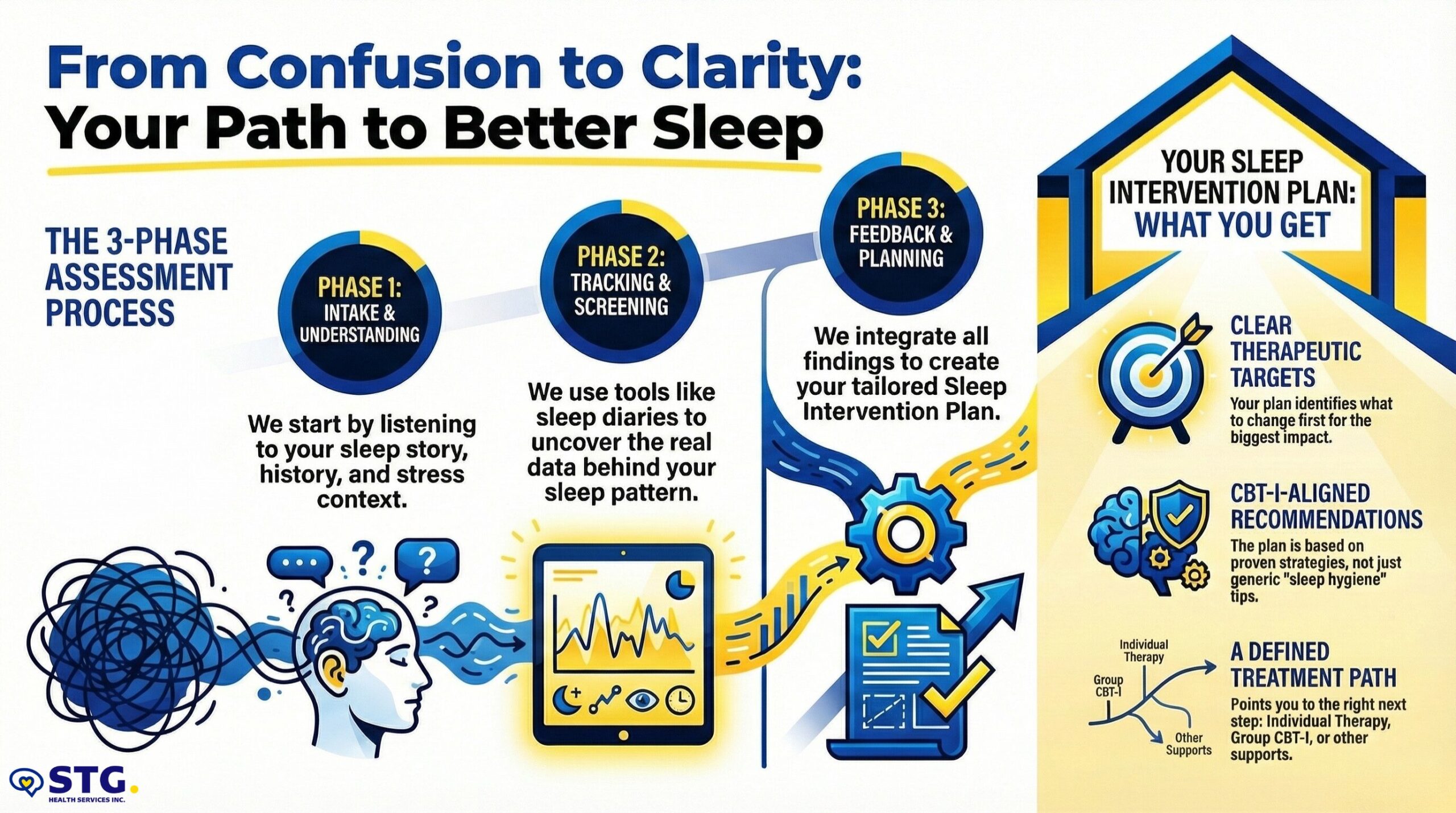
This is a structured, clinically grounded process designed to clarify your insomnia pattern and translate it into a tailored plan.
Your intervention plan is built around direction, not perfection—so change can hold under real life.
The goal is understanding and direction—so treatment becomes precise.
No. Sleep hygiene can support sleep, but it is not recommended as a stand-alone treatment for chronic insomnia. Your plan is built using CBT-I principles (multicomponent CBT-I; stimulus control; sleep restriction therapy; cognitive and arousal strategies as appropriate).
That’s exactly why we screen. The intake phase helps us identify when additional medical follow-up may be appropriate (for example, symptoms consistent with sleep-disordered breathing, circadian disruption, or other contributors). We focus on building the best intervention plan and coordinating care when needed.
Yes. We keep the process paced and collaborative. The goal is not perfection—it’s consistency. We start with the minimum effective steps (often a sleep diary baseline and one or two key changes), then adjust using your real data.
The process is structured, paced, and clinically grounded. It unfolds in three phases, each contributing to a clear understanding and coordinated next steps.
Progression occurs only as clinically appropriate—some clients need fewer steps; others benefit from a more comprehensive intake.
We begin with a focused intake to understand your sleep story and context—what your nights look like, what you’ve tried, what’s changed over time, and how stress, routines, and nervous system activation show up around bedtime.
n this phase, we use sleep tracking and targeted tools (often including a sleep diary) to clarify patterns such as sleep onset latency, wake after sleep onset, early waking, sleep timing consistency, and sleep efficiency.
Tools support clinical judgment—they don’t replace it. The goal is integration, not a pile of scores.
We integrate what we learned into a clear formulation of your maintaining loop, then create your Sleep Intervention Plan.
You receive:
Direct verbal feedback
A written summary in practical language
A tailored intervention plan outlining recommended next steps
Intervention planning may include:
A CBT-I path (individual or group) aligned with guidelines that support CBT-I as first-line behavioral treatment
A staged approach (stabilization first, then CBT-I consolidation) when clinically appropriate
Coordination/referral suggestions when medical or additional supports may be important
Whether your insomnia is primarily stress-maintained, schedule-maintained, conditioning-maintained, or a combination, you’ll leave with a plan that is specific and usable.
Your intervention plan may include:
Option A: Individual CBT-I Sleep Therapy (complex patterns, high sleep anxiety, comorbid stress) Sask Sleep
Option B: Group CBT-I (structured, affordable skill-building)
Option C: A combined approach (therapy + structured course supports)
Option D: Coordinated next steps when additional medical follow-up is advised
The goal is to support sustainable progress — not short-term fixes.
As part of your care, you may also receive access to our CBT-I Online Course—a self-paced program with short lessons and downloadable tools (including sleep diary resources). It is not a replacement for therapy or medical care; it is designed to reinforce your intervention plan between sessions and help you stay consistent when life is busy.