
TL;DR: Sleepmaxxing — optimizing every aspect of your sleep — has the right idea and the wrong playbook. Most viral sleep hacks (mouth taping, magnesium drinks, melatonin) treat surface symptoms while ignoring the real issue: your brain has learned to associate your bed with being awake. CBT-I (Cognitive Behavioural Therapy for Insomnia) is the gold-standard treatment for insomnia, recommended by every major sleep medicine body. It works for 70–80% of people who complete it, it matches sleeping pills short-term, and it outperforms them long-term — because the changes stick. If you’re in Saskatchewan, you can access CBT-I–informed sleep support via telehealth at sasksleep.com.
You’ve seen the TikToks. Mouth taping. Magnesium mocktails. Red light panels bolted to the bedroom wall like a sleep shrine. Over 100 million posts tagged #sleepmaxxing. Gen Z figured out that sleep matters. That part’s not wrong.
Here’s the part TikTok left out: most of those hacks are solving the wrong problem.
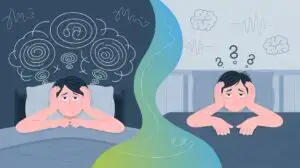
They treat your sleep like a room you need to redecorate — add the right gadgets, the right supplements, the right pillow mist, and the rest will follow. It won’t. Because for most people lying awake at 2 a.m. in Regina or Saskatoon, the issue isn’t your bedroom setup. It’s what your brain has learned to do the moment your head hits the pillow.
There’s a treatment that actually retrains that response. It’s called CBT-I — Cognitive Behavioural Therapy for Insomnia — and it’s the first-line recommendation from every major sleep medicine organization in the world. It works for 70–80% of people who complete it. Unlike that sleep tracker on your nightstand, it doesn’t just measure the problem. It solves it.
The bottom line: Sleepmaxxing is the right instinct — take sleep seriously, treat it like the health priority it is. But the method matters more than the aesthetic. CBT-I is sleepmaxxing that actually works.
Why Aren’t TikTok Sleep Hacks Working?
Let’s be fair. Not every sleepmaxxing hack is useless. Cool bedrooms? Good evidence. Consistent wake times? Excellent evidence. But the signal-to-noise ratio on social media is terrible, and the hacks that get the most views are the ones that look the most dramatic — not the ones with the strongest science.
Here’s the quick rundown:
Mouth taping — Low evidence, real risks. A 2025 systematic review flagged potentially serious harm for people taping without knowing they have sleep apnea or nasal obstruction. If you think you have a breathing issue, talk to a healthcare provider. Don’t tape your mouth shut based on a TikTok.
Magnesium drinks — Mixed evidence. Some support for sleep onset, particularly magnesium glycinate. But most people get adequate magnesium from their diet, and it’s better studied in people who don’t have a diagnosed sleep disorder.
Melatonin — Modest. It helps you fall asleep roughly 7 minutes faster. Health Canada advises against using it beyond 4 weeks without professional guidance. For chronic insomnia, it’s treating a symptom while ignoring the mechanism.
Sleep trackers — Useful for general awareness. Counterproductive when checking your “sleep score” becomes its own source of anxiety. Sleep experts have a word for that: orthosomnia.
Cool room temperature — Solid evidence. A cooler bedroom (around 18°C) supports the core body temperature drop that initiates sleep. This one’s legit.
Here’s what these hacks have in common: even the ones that help are nibbling around the edges. A cool room might help you fall asleep 10 minutes faster on a given night. CBT-I restructures the entire sleep-wake cycle. A meta-analysis of 20 randomized controlled trials found it reduced time to fall asleep by 19 minutes and time awake after falling asleep by 26 minutes — with improvements that persist and often keep improving after treatment ends.
That’s a fundamentally different kind of result.
What Is CBT-I and How Does It Work?
CBT-I isn’t a single technique. It’s a structured protocol — usually 4 to 8 sessions — that combines five components, each targeting a different reason your insomnia keeps going.
Think of it this way: if sleepmaxxing is about optimizing every variable, CBT-I is sleepmaxxing done right. It just optimizes the variables that actually matter.
Sleep restriction. This is the one that surprises everyone. If you’re spending 9 hours in bed but only sleeping 6, your brain has learned that bed means lying awake. Sleep restriction compresses your time in bed to match your actual sleep time. Yes, you’ll be tired at first. That’s the mechanism — the mild sleep deprivation builds sleep pressure, so when you do go to bed, you actually sleep. As your efficiency improves past 85%, you gradually add time back. A 2024 analysis of 80 studies confirmed this is the single most effective individual component of CBT-I.
Stimulus control. Your brain is an association machine. Months of lying in bed scrolling, watching the clock, worrying — and now bed means awake. Stimulus control breaks that link. The rules: go to bed only when you’re genuinely sleepy. If you’re awake for ~20 minutes, get up, do something boring, come back when sleepiness returns. Bed is for sleep only. And — this is the hard one — same wake time every morning, weekends included.
Cognitive restructuring. This is where CBT-I separates from basic sleep hygiene. Insomnia isn’t just a behaviour problem — it’s a thinking problem. “I need 8 hours or I can’t function.” “If I don’t fall asleep soon, tomorrow is ruined.” “I’ve always been a bad sleeper.” These thoughts feel true, but they generate the exact hyperarousal that prevents sleep. Cognitive restructuring means examining these beliefs against actual evidence. It’s harder than buying a supplement. It’s also the reason CBT-I produces results that last.
Sleep hygiene. This overlaps most with sleepmaxxing content — temperature, light, caffeine, alcohol — and matters least in isolation. Research confirms sleep hygiene alone doesn’t resolve clinical insomnia. But as part of the full protocol, it matters.
Relaxation training. Progressive muscle relaxation, diaphragmatic breathing, body scans. Not TikTok breathing hacks — structured skills that reduce physiological arousal over time. Most people need 2–3 weeks of daily practice before these reliably help. If you try it once and it “doesn’t work,” you’re still training. That’s normal.
Key insight: CBT-I doesn’t mask a symptom. It retrains the system — your nervous system, your thought patterns, your behavioural habits around sleep. It’s the most studied, most recommended, most durable treatment for insomnia in existence.
Why Does Saskatchewan Make Sleep Harder?
Generic sleep advice doesn’t account for what it’s like to live here.
Saskatchewan has some of the most extreme light variation in the country — nearly 17 hours of daylight in June, under 8 hours in December. That swing directly impacts your circadian rhythm.
In summer, a 5 a.m. sunrise will wake you up whether you want it to or not. Blackout curtains aren’t a luxury — they’re a circadian necessity.
In winter, the sun doesn’t show up until after 9 a.m. in December. Morning light exposure is one of the most powerful tools for anchoring your sleep-wake cycle, and you may need to manufacture it artificially. A 10,000-lux light therapy lamp at your breakfast table for 20–30 minutes within an hour of waking can do what the sun isn’t available to do. Research suggests that every 30 minutes of morning sun exposure before 10 a.m. is associated with a 23-minute shift in sleep timing.
And the numbers here are worth knowing. About 16.3% of Canadian adults meet clinical criteria for insomnia disorder — but in two Saskatchewan Cree communities studied by the University of Saskatchewan, nighttime insomnia symptom rates reached 32.6%, driven by a complex web of chronic pain, depression, and the intergenerational impacts of colonization. Sleep problems in this province aren’t abstract. They’re the person across from you at the coffee shop in Moose Jaw who hasn’t slept through the night in three years.
What About ADHD and Sleep?
Here’s something the sleepmaxxing world almost never talks about: ADHD and insomnia are deeply connected.
Research consistently shows that 40–70% of adults with ADHD report significant sleep problems. Many have delayed circadian rhythms — meaning their internal clock is biologically shifted later than the schedule their life demands. You’re not sleepy at a “normal” bedtime, you lie awake for hours, and then you can’t wake up in the morning. It’s not laziness. It’s a circadian mismatch.
CBT-I works for ADHD-related insomnia, but it usually needs modifications. Sleep restriction timing may need to account for a later chronotype. Stimulus control can be harder when executive function challenges make structured rules harder to follow consistently. Morning light exposure becomes even more critical. And the cognitive restructuring piece may need to address ADHD-specific patterns — the racing mind at bedtime, the time blindness, the shame spiral about not being able to do “something as basic as sleep.”
If you have ADHD and insomnia, working with a provider who understands both isn’t optional. At STG Health, we work with adults across Saskatchewan navigating exactly this intersection. Learn more at saskadhd.com or sasksleep.com.
Your 7-Day Sleep Reset Starter Plan
This isn’t a replacement for professional CBT-I. It’s a structured starting point — enough to build awareness and help you decide if full treatment is the next step.
Days 1–2: Observe. Start a sleep diary. Every morning, record when you went to bed, roughly how long it took to fall asleep, how many times you woke up, and when you got up for good. Calculate your sleep efficiency: (total sleep ÷ total time in bed) × 100. Don’t change anything yet. Just notice. Most people are surprised.
Days 3–5: Restrict and restructure. Based on your diary, set a sleep window matching your actual sleep time. If you averaged 6 hours of sleep, your window is 6 hours — say, midnight to 6 a.m. (Minimum: 5 hours. Don’t go below that without a clinician.) Bed is for sleep only. If you’re awake ~20 minutes, get up. Same wake time every morning. This will be uncomfortable. That’s the mechanism working.
Days 6–7: Add awareness. Start noticing your sleep-related thoughts. When you catch “I’ll never fall asleep” or “tomorrow is going to be terrible,” write it down. You don’t need to challenge it yet — just notice. Add 10 minutes of progressive muscle relaxation before bed.
Saskatchewan tip: In winter, get 20–30 minutes of bright light within an hour of waking — a 10,000-lux lamp if the sun isn’t up yet. In summer, use blackout curtains aggressively.
When Is CBT-I the Right Call?
CBT-I is designed for: Difficulty falling or staying asleep, 3+ nights per week, for 3+ months. That’s the clinical definition of chronic insomnia, and CBT-I is specifically built for it.
It also works well for: Sleep problems linked to anxiety, depression, PTSD, or burnout. Research shows it can improve depression outcomes and reduce suicidal ideation when used alongside standard treatment. For burnout-related insomnia — the “can’t turn off at night” pattern — it addresses the hyperarousal directly.
It works with modifications for: ADHD with chronic sleep-onset insomnia. Shift work. Medication tapering (work with your prescriber and CBT-I provider together).
See a doctor first for: Loud snoring, gasping, or witnessed apneas (possible sleep apnea). Restless legs or periodic limb movements. These are distinct conditions that may need medical evaluation before CBT-I.
You probably don’t need full CBT-I for: Occasional bad nights around stressful events. Sleep hygiene and relaxation techniques may be enough.
Is CBT-I Better Than Sleeping Pills?
For chronic insomnia, yes. The research is clear on this.
CBT-I matches medication effectiveness during the first 4–8 weeks of treatment. After that, it pulls ahead — because the improvements persist and often continue improving after treatment ends. Sleeping pills stop working when you stop taking them. CBT-I teaches your brain something it keeps.
And CBT-I doesn’t come with tolerance, dependence, or daytime drowsiness. There’s also emerging evidence it may reduce suicidal ideation: a randomized trial of 658 adults found that digital CBT-I cut rates of suicidal ideation from 70% to 30% among those with baseline suicidal thoughts, with benefits persisting at one-year follow-up.
What Should You Actually Spend Money On?
Worth it: A 10,000-lux light therapy lamp (essential for Saskatchewan winters). Blackout curtains (essential for Saskatchewan summers). A paper sleep diary (free, and more useful than any tracker for CBT-I purposes). A white noise machine (because it’s Saskatchewan, and the wind doesn’t stop). A boring book for those 20-minute “get out of bed” intervals.
Skip: Sleep tracking rings as a treatment tool (fine for awareness, counterproductive when the score becomes a source of anxiety). Melatonin for chronic insomnia (narrow evidence base, treats a symptom). Mouth tape (unfavourable risk-benefit for most people).
Frequently Asked Questions
What is sleepmaxxing? Sleepmaxxing is the practice of optimizing every aspect of your sleep — environment, habits, supplements, timing — for the best possible rest. It started as a TikTok trend and has over 100 million posts. The idea that sleep deserves serious attention is sound. The most effective version of sleepmaxxing is grounded in CBT-I: a structured protocol that retrains your brain’s relationship with sleep.
Can I get CBT-I in Saskatchewan? Yes. STG Health offers CBT-I–informed sleep support via telehealth across the province through sasksleep.com. Whether you’re in Regina, Saskatoon, Prince Albert, or La Ronge, you can access it without leaving home.
How long does CBT-I take to work? Most people notice meaningful improvement within 4–6 weeks. Sleep restriction often produces changes in the first 1–2 weeks — you’ll be sleepier at first, but your sleep efficiency rises quickly. Cognitive restructuring takes longer, but the combined effect is durable.
What if I’ve tried “everything” and nothing works? That’s actually a common starting point for CBT-I. Many people arrive after years of supplements, apps, and medications — none of which addressed the underlying patterns maintaining their insomnia. CBT-I targets those patterns directly. If nothing else has worked, this is likely the thing that hasn’t been tried yet.
Can insomnia make anxiety or burnout worse? Absolutely. Insomnia and anxiety amplify each other. The same is true for burnout: the hyperarousal that prevents sleep is often the same stress response driving professional exhaustion. Treating insomnia with CBT-I can improve anxiety and burnout symptoms even when those conditions aren’t being directly targeted.
Ready to Actually Fix Your Sleep?
Sleepmaxxing got one thing right: sleep matters. It matters for your mood, your cognition, your immune function, your metabolic health — and yes, the way you look and feel.
But optimization without structure is just experimentation. And when you’re lying awake at 3 a.m. with a magnesium supplement on your nightstand and mouth tape peeling off your face, experimentation starts to feel a lot like desperation.
CBT-I offers something different. Not another product. Not another hack. A genuine retraining of the system. And it’s available in Saskatchewan right now, through telehealth.
Start here: Book your initial sleep assessment at sasksleep.com.