
TL;DR: Chronic insomnia isn’t a willpower problem—it’s a neurological state where wake and sleep circuits activate simultaneously. Counterintuitive solutions like spending less time in bed, understanding your brain’s “hybrid states,” and addressing circadian rhythm dysfunction prove more effective than common sleep aids. The science reveals insomnia as a complex disorder of brain circuitry and biological rhythms, with serious long-term health consequences including 40% increased bipolar disorder risk and accelerated cognitive decline.
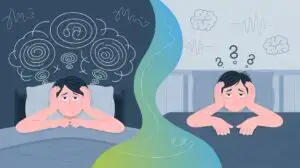
We’ve all been there: staring at the ceiling at 3 A.M., body exhausted but mind buzzing. The more you try to force sleep, the more elusive it becomes. This “racing mind” feels like a personal failure, a sign that you just can’t switch off. But what if this nightly struggle isn’t about a lack of willpower? What if it’s rooted in complex, counter-intuitive biological processes?
Science is revealing that insomnia is far more than just being tired. It’s a state of profound neurological dysregulation with surprising causes and equally surprising solutions that go far beyond the usual advice to “just relax.” Here are six scientific truths that reframe our understanding of chronic sleeplessness.
1. The Sleep Restriction Paradox: To Sleep More, You First Have to Spend Less Time in Bed
Key Insight: Deliberately limiting time in bed strengthens your brain’s association between bed and sleep, making chronic insomnia more treatable than prolonging sleep opportunity.
It sounds like a paradox, but one of the most effective treatments for chronic insomnia involves deliberately restricting your time in bed. This technique, called Sleep Restriction Therapy (SRT), is a cornerstone of Cognitive Behavioral Therapy for Insomnia (CBT-I)—recommended by the American College of Physicians as the first-line treatment for chronic insomnia.
Many people with insomnia do the opposite: they go to bed earlier or stay in bed longer, hoping to “catch up” on sleep. This approach, called sleep extension, is a trap. By spending excessive time in bed while awake—sometimes 9-10 hours trying to achieve 5-6 hours of actual sleep—you create a critical mismatch between your sleep opportunity (time in bed) and your sleep ability (the actual amount you can sleep). This mismatch weakens the association between your bed and sleep, perpetuating the cycle of sleeplessness.
How SRT works in practice: A sleep specialist calculates your current average sleep duration (say, 5.5 hours) and restricts your time in bed to match that window—no more. Initially, this creates mild sleep deprivation, which builds up your natural homeostatic sleep drive (the biological pressure for sleep that accumulates during wakefulness). This pressure makes you fall asleep faster and sleep more consolidated. As sleep efficiency improves (typically measured as time asleep divided by time in bed), the window gradually expands by 15-30 minute increments.
CBT-I, which includes SRT alongside stimulus control and cognitive restructuring, proves more effective than sedative-hypnotics in long-term outcomes, with benefits persisting years after treatment ends.
2. The Hybrid Brain State: Your Brain Isn’t Just ‘On’ or ‘Off’—It Can Be Both Simultaneously
Key Insight: Insomnia creates a neurological “flickering switch” where sleep-promoting and wake-promoting brain circuits activate at the same time, explaining why sleep feels unrefreshing.
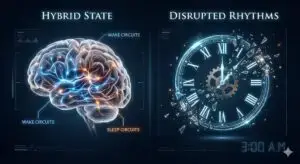
The feeling of being “half-awake” all night isn’t just subjective—it’s a neurological reality. Groundbreaking research suggests that chronic insomnia is not a state of pure wakefulness but a “hybrid state” where sleep-promoting and wake-promoting brain circuits fire simultaneously.
Instead of the healthy brain’s clean “flip-flop switch” that transitions between sleep and wake, the insomniac brain acts more like a “flickering switch.” Animal models of stress-induced insomnia demonstrate this instability arises from the simultaneous activation of brain systems (the ventrolateral preoptic nucleus for sleep and the locus coeruleus for arousal) that are normally mutually exclusive.
Human evidence from brainwave studies: Electroencephalogram (EEG) research provides biological proof of this hybrid state. Even during periods objectively classified as sleep, the brain activity of individuals with insomnia shows significantly more “wake-like” patterns. A measurement called the Wake EEG Similarity Index (WESI) found that people with chronic insomnia have wake-like brainwave activity during N1, N2, and even REM sleep stages—providing a biological basis for the common experience of unrefreshing sleep and the sensation of “never really sleeping.”
This explains why insomniacs often underestimate their total sleep time and why mornings feel as exhausting as bedtime.
3. The Broken Circadian Rhythm: That ‘Racing Mind’ at 3 A.M. Isn’t Just Anxiety—It’s a Biological Clock Dysfunction
Key Insight: The 3 A.M. racing thoughts reflect a flattened circadian rhythm of cognitive activity—your brain’s natural shutdown mechanism for problem-solving fails to activate at night.
The relentless, goal-oriented thoughts that plague insomniacs at night have a clear biological signature: a flattened circadian rhythm of cognitive activity.
In healthy sleepers, the brain naturally disengages from daytime problem-solving as evening approaches. Goal-oriented, “sequential” thinking quiets down as the body’s internal clock signals it’s time for rest. This cognitive down-regulation is as automatic as your body temperature dropping in the evening. For people with chronic insomnia, this down-regulation fails to occur. Their minds remain stuck in problem-solving mode, churning through plans, worries, and to-do lists with the same intensity as 2 P.M.
In a rigorously controlled study requiring participants to remain awake for 24 hours under constant conditions (constant routine protocol), researchers discovered that people with insomnia maintained daytime-like mental activity deep into the biological night when circadian pressure should suppress such thinking. As lead researcher Professor Kurt Lushington noted: “Their thought patterns stayed more daytime-like in the night-time hours when the brain should be quietening.”
This isn’t psychological rumination that can be “thought away”—it’s a circadian dysfunction where the brain’s master clock fails to signal cognitive systems to power down. This explains why cognitive techniques alone often fall short without addressing underlying circadian rhythm disturbances.
4. The Long-Term Health Consequences: Chronic Sleeplessness Isn’t Just Tiring—It’s a Serious Disease Risk Factor
Key Insight: Chronic insomnia and circadian disruption increase bipolar disorder risk by 40% and accelerate Alzheimer’s progression by impairing the brain’s nightly waste-clearance system.
While the immediate effects of a bad night’s sleep are obvious—fatigue, irritability, difficulty concentrating—the long-term consequences of chronic insomnia are far more serious and systemic than previously understood.
Mental health vulnerability: A major meta-analysis of prospective studies found that pre-existing sleep and circadian rhythm disturbances were associated with a 40% increased risk of bipolar disorder onset. This isn’t correlation masking reverse causation—these were longitudinal studies where sleep disturbances preceded mood episodes. The finding highlights the profound link between our internal clocks and mental health stability, suggesting that chronic circadian disruption may trigger vulnerable neurological systems into dysregulation.
Neurodegenerative disease acceleration: Poor sleep quality is increasingly linked to Alzheimer’s disease through a specific mechanism. During deep, slow-wave sleep (Stage N3), the brain activates its “glymphatic system”—a waste-clearance network discovered only in 2012 that flushes out toxic proteins, including β amyloid (Aβ). The buildup of Aβ plaques in brain tissue is a pathological hallmark of Alzheimer’s disease.
When chronic insomnia disrupts deep sleep architecture, this critical cleaning process becomes impaired. Studies using PET imaging show that even one night of sleep deprivation increases Aβ accumulation in brain regions vulnerable to Alzheimer’s. Over years of poor sleep, this impaired clearance potentially contributes to the accumulation of neurotoxic proteins and accelerates cognitive decline.
This evidence establishes chronic insomnia not as a mere quality-of-life issue but as a modifiable risk factor for serious neurological and psychiatric conditions.
5. The Non-Visual Light Detection System: Your Body Clock Can ‘See’ Light, Even If Your Eyes Can’t
Key Insight: The brain’s master clock uses specialized melanopsin cells—not visual rods and cones—to detect light, explaining why some blind individuals maintain normal sleep-wake cycles while others experience free-running circadian rhythms.
Your ability to see has almost nothing to do with how your brain senses daylight for circadian regulation. The body’s master clock, located in the suprachiasmatic nucleus (SCN) of the hypothalamus, synchronizes to the 24-hour day primarily through light exposure. But surprisingly, this process doesn’t rely on the rods and cones we use for vision.
Instead, the SCN receives light information through a specialized set of “melanopsin-containing retinal ganglion cells” (intrinsically photosensitive retinal ganglion cells, or ipRGCs). These photoreceptors are exquisitely sensitive to blue-spectrum light but are not involved in forming images. They function as the body’s dedicated “circadian light detectors.”
Clinical implications: This discovery has fascinating consequences. Some totally blind individuals—those who’ve lost rod and cone function but retain functional melanopsin cells—can still have their circadian rhythms entrained by bright light therapy. Their biological clocks remain synchronized to the 24-hour day despite complete visual blindness.
Conversely, an estimated 50% of totally blind people have non-entrained, or “free-running,” circadian rhythms. Without the primary light cue to anchor their internal clock to the 24-hour day, their sleep-wake cycle drifts progressively later each day (typically by 15-60 minutes daily), creating a rotating pattern of insomnia and excessive daytime sleepiness that cycles every few weeks.
This explains why light therapy timing and intensity matter so profoundly for circadian disorders—and why dim evening light from screens can disrupt sleep even when it’s not subjectively “bright.”
6. The OTC Sleep Aid Trap: That Common Over-the-Counter Medication Might Be Making Things Worse
Key Insight: First-generation antihistamines develop tolerance to sedative effects within just 3 days, disrupt natural sleep architecture, and cause next-day cognitive impairment—making them ineffective and potentially harmful for chronic insomnia treatment.
Desperate for sleep, many people turn to over-the-counter (OTC) sleep aids, most of which contain first-generation antihistamines like diphenhydramine (the active ingredient in products like Benadryl and some formulations of Unisom—always check the label, as Unisom also comes in a different formulation with doxylamine). While these medications can induce drowsiness, they are not recommended for treating insomnia by sleep medicine specialists.
Rapid tolerance development: The sedative effects develop tolerance incredibly fast—often within just three days of nightly use. After that brief period, they become no more effective than placebo for inducing sleep, yet many people continue using them for weeks or months.
Sleep architecture disruption: Beyond ineffectiveness, these medications actively disrupt your natural sleep architecture. They suppress REM sleep and reduce deep slow-wave sleep, creating the same “unrefreshing sleep” problem they’re meant to solve. You might be unconscious for 7-8 hours, but the sleep quality is significantly compromised.
Next-day cognitive impairment: First-generation antihistamines are notorious for causing residual drowsiness and “hangover” effects that persist 8-12 hours after ingestion. Studies show measurable impairment in attention, memory, and psychomotor performance the following day—roughly equivalent to a blood alcohol level of 0.05-0.10%. For anyone driving, operating machinery, or requiring cognitive precision, this creates serious safety concerns.
The prescription alternative problem: Even prescription sedative-hypnotics (benzodiazepines and “Z-drugs” like zolpidem) carry risks including dependency, tolerance, and rebound insomnia upon discontinuation—which is why CBT-I remains the gold-standard first-line treatment.
Understanding the Complexity: Your Sleep Is More Nuanced Than You Think
Chronic insomnia is not a simple problem of being too stressed or not tired enough. It is an active, complex disorder involving genetics, brain circuitry dysregulation, and the powerful circadian rhythms that govern every cell in our bodies. Understanding these scientific truths moves us beyond self-blame and frustration toward more effective, evidence-based solutions.
The research reveals that treating chronic insomnia requires addressing multiple systems: strengthening the homeostatic sleep drive through sleep restriction, recalibrating circadian rhythms through properly timed light exposure, and retraining the brain’s sleep-wake circuitry through behavioral interventions. Quick fixes like antihistamines or “sleep hygiene tips” fail because they don’t address these underlying mechanisms.
When to seek professional help: If you’ve experienced difficulty falling asleep, staying asleep, or unrefreshing sleep for more than three months, occurring at least three nights per week despite adequate opportunity for sleep, you meet clinical criteria for chronic insomnia disorder. A sleep medicine specialist or therapist trained in CBT-I can provide structured treatment targeting these biological mechanisms.
Knowing that your brain has its own powerful rhythms, what’s one small change you could make to start listening to them?
Frequently Asked Questions About Insomnia
How long does insomnia last? Acute insomnia (lasting days to weeks) often resolves when the triggering stressor passes. Chronic insomnia persists for three months or longer, occurring at least three nights per week, and typically requires structured treatment like CBT-I rather than resolving spontaneously.
Is insomnia dangerous? Chronic insomnia significantly increases health risks, including 40% elevated risk for bipolar disorder onset, accelerated Alzheimer’s progression through impaired glymphatic clearance, and increased cardiovascular disease and metabolic syndrome risk. It’s not merely uncomfortable—it’s a modifiable disease risk factor.
What helps racing thoughts at night? Racing thoughts reflect circadian dysfunction where problem-solving brain activity fails to quiet naturally. Effective interventions include cognitive defusion techniques (observing thoughts without engaging), scheduled “worry time” earlier in the day, and addressing underlying circadian rhythm disruption through properly timed light exposure and sleep-wake scheduling.
Do sleep aids work for chronic insomnia? Over-the-counter antihistamines develop tolerance within 3 days and disrupt sleep architecture. Prescription sedatives carry dependency risks and prove less effective than CBT-I in long-term outcomes. CBT-I remains the evidence-based first-line treatment, with benefits persisting years after treatment.
How do I fix my circadian rhythm? Circadian recalibration requires consistent sleep-wake timing (even on weekends), properly timed bright light exposure (morning light advances your clock; evening light delays it), and strategic light avoidance in the evening. Changes typically require 1-2 weeks of consistent implementation to stabilize.